Have you ever watched a child successfully read a word like “elephant” and then, only a few lines later, stumble over a tiny word like “the”? It can seem puzzling. Surely a three-letter word should be easier than an eight-letter word? But when we look beyond the number of letters and think about how a learner makes sense of words, a different picture can begin to emerge.
For some dyslexic learners, the difficulty isn't necessarily about how long or complicated a word looks. Sometimes, it can be about whether the word creates a clear picture or meaning in their mind. Think about the word “elephant.” As soon as you read it, you may picture a large grey animal with enormous ears and a long trunk. You might remember seeing an elephant in a book, a film or at a zoo. There is something concrete for your mind to connect with.
Now think about the word “the.” What does the look like? That's much harder to answer. There isn't an obvious object, action or picture attached to it. Yet words like the, of, for, from, by, at, about and as appear everywhere in reading and writing. For someone who naturally thinks strongly in pictures, these small and seemingly simple words can sometimes create more uncertainty than a much longer word with an obvious image.
Small words don't always have small meanings
Another interesting thing about these little words is that they aren't necessarily simple. A single word can have several meanings depending on how it is being used. Take the word “about.” We might say, “We talked about the book.” (on the subject of) We could also say, “There were about ten people,” (approximately) or “She walked about the garden.” (here and there) It is the same word, but its meaning changes with each sentence.
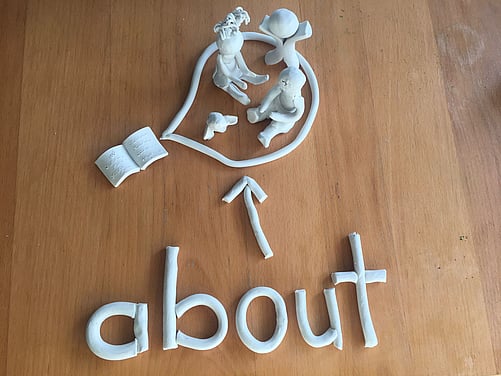
The clayed meaning of about in the picture is: "The book is about three people and a penguin." (on the subject of)
In fact, there are about 8 or 9 different meanings of 'about'.
A learner might recognise the letters a-b-o-u-t and even be able to say the word aloud, but recognising a word isn't necessarily the same as having a clear understanding of its meaning. If that meaning isn't clear, the word can interrupt the flow of reading. When this happens repeatedly with words that appear again and again on a page, reading can become much harder work.
Understanding trigger words
In the Davis® approach, words that can cause this kind of confusion are often referred to as trigger words: they can trigger a loss of focus for a picture-thinker or visual-spatial learner. Many of these words are short, commonly used words, which means a learner may encounter them repeatedly within just a few sentences.
Imagine reading a page where some of the most frequently occurring words don't immediately give you a clear sense of meaning. Even though the word may look simple to someone else who already knows the word, encountering that uncertainty again and again can make the whole reading experience more demanding for the dyslexic picture-thinker.
Observe your own child reading. When they come to one of these little words (usually those on the essential word list, heart word list or sight word list) do they tend to become confused, and lose focus? Does your child start to skip those words reading ahead to find a word that helps make sense of the story - a word like horse or penguin that does have a naturally occurring picture?
Maybe they try to guess the word? Do you see your child looking at just the first letter such as 'm' then start blindly guessing... meant, maybe, might... until you say , 'Yes that one.'
Often these little words are also hard to sound out - such as the word many where the letter a is actually an 'e' sound! Did you know the letter a has 9 different sounds in different words?
This is why it can be helpful to move away from the assumption that a small word should automatically be an easy word. What looks simple on the page may not feel simple to the person trying to make sense of it. Davis Methods have a fun and easy way to help with this.
Giving a word meaning
This is where Davis Symbol Mastery® offers a different way of working with words. Rather than relying only on repetition or asking the learner to memorise a word again and again, the learner explores what that word actually means.
Using clay, they can create a three-dimensional model that represents the meaning of the word. They also work with the letters of the word and how the word is spoken. This gives the learner an opportunity to connect what the word looks like, what it sounds like and what it means.
For a learner who thinks strongly in pictures, making an abstract word more concrete can provide another way into understanding it. A word that previously felt like a collection of letters can begin to carry meaning.
And when a word has several meanings, there is more to explore. Instead of simply being told what a word means, the learner can discover how it works in different situations and build a clearer understanding of it. They won't need to clay every meaning of every word as we teach a wonderfully visual way to read as well. If you have a question about this, please Contact Claire at Growing Choices.
Looking beyond what we see on the page
When a child repeatedly hesitates over a word they have seen many times, it can be tempting to think, “But they knew this yesterday,” or “We've practised this so many times.” We may naturally wonder why they can't remember such a simple word.
But perhaps there's another question we can ask.
Does this word have a clear meaning for them?
Can they picture it? Do they understand how its meaning changes in different sentences? Are they connecting the written word with an idea, or have they simply been trying to remember the shape of the letters?
Becoming curious about how a child is experiencing the word can help us see beyond the difficulty itself. Instead of asking why they can't learn something in the way we expect, we can begin asking what might help that learning make sense to them.
Sometimes, a long word like “elephant” can be easy to imagine, while a tiny word like “the” can be surprisingly difficult to grasp.
And sometimes, understanding why that happens can help us find a way in. 🌱
Curious to look at dyslexia differently?
If this has made you curious about the way a dyslexic learner may experience words, reading, and the world around them, we'd love to invite you to our free online screening of WHO KNEW? Dyslexia is a Way of Thinking.
We'll watch the film together and have time afterwards for questions and conversation.
Tuesday 13 October or Tuesday 20 October
7:00pm NZT | 5:00pm AEST
Register for the free WHO KNEW screening.
Greater Understanding. A Brighter Future.