Have you ever looked at your child and thought,
"I know you can do this… so what's getting in the way?"
Perhaps your child explains the maths problem perfectly on the way home from school. They tell you all about the book they're reading or confidently answer your questions over dinner. Then, a little later, they sit down to complete the homework and everything changes. They can't seem to get started. They forget what to do next, frustration grows, and before long you're both wondering what happened.
If this sounds familiar, you're certainly not alone.
Over the years, I've spoken with many parents who have shared this same concern. They aren't questioning whether their child is intelligent. In fact, they often tell me the opposite. They know their child is capable. What they can't understand is why someone who clearly knows the answer struggles to show what they know.
Sometimes, the answer isn't about trying harder. Sometimes it's about understanding how your child learns.
If you're beginning to wonder whether there's more to your child's learning struggles than meets the eye, you might like to download our Free Parent Guide, where I explore some of the hidden reasons bright children can struggle at school and what you can do to help.
Looking Beneath the Surface
When children struggle to start a task, remember instructions or stay organised, it's easy to focus on what we can see. Homework becomes a battle. Simple routines feel overwhelming. We begin asking, "Why won't they do it?"
At Growing Choices, we often encourage parents to ask a different question.
"What might be making this difficult?"
That shift from frustration to curiosity is often where understanding begins.
It's also closely connected to something we call Orientation. When children are well orientated, learning becomes calmer, clearer and more meaningful. If you'd like to explore this further, you may enjoy reading Orientation – Where Learning Begins.
For many children, another important part of the picture is Executive Function.
You don't need to remember the name. What's important is recognising what it looks like. Executive Function helps children organise themselves, manage their attention, remember instructions and move through a task from beginning to end.
Imagine trying to keep track of several conversations while someone keeps handing you another job to do. That's a little like what everyday learning can feel like for a child whose Executive Function skills are under pressure.
If there is anything else going on for a child, such as dyslexia, ADHD, anxiety, stress or other learning differences, it can add another layer of disorientation, distraction, or confusion. Instead of one challenge, they're trying to manage several at once, making everyday learning feel even more overwhelming.
If you've wondered whether attention could also be part of your child's learning journey, you may find our blog What If ADHD Isn't About a Lack of Attention? helpful.

Knowing Isn't Always the Same as Understanding
One of the things that has always fascinated me is how often children can tell us the answer but struggle to show us the answer.
Parents say things like,
"They explained it perfectly in the car."
"They answered every question when we talked about it."
"So why couldn't they do it once they got home?"
Usually, the learning hasn't disappeared.
Knowing something and being able to organise, retrieve and apply that knowledge are different parts of learning. Executive Function plays an important role, but over the years I've learnt there is another piece of the puzzle.
It's called Concept Mastery.
When Learning Begins to Make Sense
Children often become very good at memorising information. They learn spelling words, repeat definitions or remember maths facts. Yet memorising isn't always the same as understanding.
Concept Mastery is about helping children create meaning.
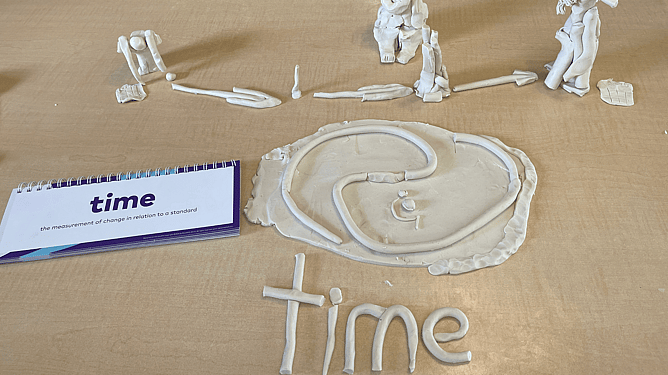
Think about the concept of time. A child may be able to read the word time, spell it correctly or recognise it in a book. But do they truly understand what time means? Can they picture yesterday, today and tomorrow? Do they understand waiting, planning ahead or how long ten minutes really feels?
When children explore a concept like time through hands-on learning experiences, it becomes much more than a word to remember. It becomes something they can understand, connect with and apply in everyday life. That's when learning begins to make sense.
This is one of the reasons I value the Davis® Method so highly. Rather than asking children to simply work harder, it helps them build understanding through meaningful experiences. As understanding grows, confidence often grows with it.
Every child is different, which is why Growing Choices offers a range of Davis® programmes designed to support executive functioning at different ages and stages. Some parents choose to begin by learning these ideas themselves through our Davis® Parent Power – Dyslexia online programme. Others may benefit from one of our one-to-one programmes, including Davis® Mastery for Attention, Davis Concepts for Life® (ages 10 to adult), Davis Concepts for Life® - Early Years (ages 8–10), or Davis® Stepping Stones (ages 5–7). Together, these programmes help children and families build understanding, confidence and lifelong learning skills.
A Different Way of Seeing Your Child
One of the greatest privileges of my work is watching parents begin to see their child differently.
The child who appeared forgetful is often working incredibly hard.
The child who seemed distracted may actually be overwhelmed.
The child who knows the answer but can't do the task isn't showing us a lack of ability. They're showing us that learning doesn't yet make sense in the way they need it to.
When we begin to understand that, everything changes.
Parents replace frustration with curiosity.
Children begin to feel understood instead of judged.
Confidence grows because learning finally begins to make sense.
At Growing Choices, we believe every child has strengths waiting to be discovered. Our role isn't to change who they are, but to help them understand how they learn best.
A Gentle Invitation
If this sounds like your child, perhaps the next step isn't finding another strategy or asking them to try harder. Perhaps it's taking the time to understand what's happening beneath the surface.
A Learning Clarity Call is simply a conversation. It's an opportunity to explore your child's learning journey, talk about the challenges you're seeing and discover whether the Davis® Method could help your child experience learning in a way that finally makes sense.
Every child deserves the opportunity to experience success in a way that makes sense to them.
Sometimes, the first step isn't changing the child.
It's changing the way we understand their learning.
And from there, everything else can begin to grow.